
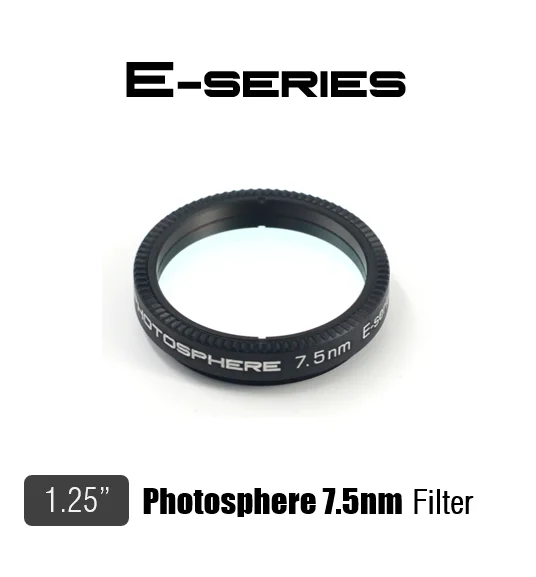
Player One 1.25" Photosphere 7.5nmnm Filter For Solar Granulation and Sunspot Details LD2083A
You will be redirected to AliExpress to complete your purchase
Specifications
- Brand Name
- Player One
- Size
- 1.25inch(31.7mm)
- Type
- Monocular
- High-concerned chemical
- None
- Model Number
- Player One 1.25inch PS 7.5nm filter
- Surface Quality
- 60/40
- Thickness
- 2mm
- Filter Type
- PS 7.5nm 1.25" Filter
- Clear Aperture
- 28mm
- Origin
- Mainland China
- Astronomy Telescope filter
- Astrophotography for telescope
- Player One 1.25inch PS 7.5nm filter
- for Binoculars monocular
- player one PS 7.5nm 1.25" Filter
- Standard M28.5*0.6mm
- PS 7.5nm Filter 1.25inch
- for Eyepiece
- 100% Original for Factory
- for Astronomy Telescope Eyepiece
- player one 1.25" Filter PS 7.5nm
- Filter for telescope
- Astronomical Filter
- 1.25" PS 7.5nm Filter
- for Astrophotography
- PS 7.5nm Filter Astronomic
Product Description
Player One 1.25" Photosphere 7.5nmnm Filter For Solar Granulation and Sunspot Details
Note: Photosphere filter is an assistant filter, telescope must use Baader film or Herschel wedge for adequate reduction of sun light, then you can use this filter for imaging.
Why to use a photosphere filter?
As we know, we doing solar photosphere imaging, usually use Herschel wedge to get best contrast, maybe add an IR685 filter to improve seeing condition. But, it’s not the best way to shoot photosphere.
Photosphere has best detail and contrast at almost 540nm, with this photosphere 7.5nm filter; you will be able to get some impressive solar granulation and sunspot details.
Features:
1. Player One PS125E filters using high quality optical glass substrate and multi-layer composite coating technology, which has excellent optical performance in astrophotography.
2. Photosphere filter is a narrowband filter, CWL is 540nm, bandwidth 7.5nm.
3. Photosphere filter is an assistant filter, telescope must use Baader Solar Filter or Herschel wedge for adequate reduction of sun light, then you can use this filter for imaging.
4. Usually, we recommend setup your photosphere filter on T-mount; this also can help you against dust drop on camera glass.
5. Specifications: 1.25 inch, thread M28.5*0.6
6. Thickness: 7mm
7. Thickness of filter lens: 2mm
8. FWHM: 7.5nm
9. CWL: 540nm
10. PV: 1/4λ
11. Transmittance: 97%
12. Blocking depth: OD3
13. Net Weight: 7g
Package Details:
PS 7.5nm 1.25" Filter
Sturdy Plastic Case
Pros & Cons
Pros
- Precision 7.5nm filter designed for clear, detailed solar granulation and sunspot astrophotography
- Standard 1.25 inch threading compatible with most popular astronomy eyepieces, monoculars, and binoculars
- High 60/40 surface quality for distortion-free image capture
- 100% factory original part for reliable performance
Cons
- Requires additional solar reduction equipment (Baader film or Herschel wedge) for safe use, adding extra cost and setup steps
- Only designed for solar astrophotography, with limited use for other astronomical imaging
- Small 28mm clear aperture restricts field of view for some telescope setups
- No included storage case to protect the delicate filter from scratches or damage
Common Questions
What materials is this solar filter made of?
The product is a precision PS 7.5nm filter with a 2mm thickness and 60/40 surface quality, though exact base materials are not fully detailed beyond the filter specs.
What are the key size specifications of this filter?
It is a 1.25 inch (31.7mm) filter with a 28mm clear aperture and 2mm thickness, with standard M28.5*0.6mm threading.
What astronomy equipment is this filter compatible with?
It fits 1.25 inch eyepieces, monoculars, and binoculars, and is designed for use with solar astrophotography setups.
What is this solar filter used for?
It is optimized for capturing sharp details of solar granulation and sunspots during solar astrophotography, as a companion filter.
What shipping details are available for this product?
This product originates from Mainland China, and shipping options will vary by the retailer selling the item.
Product information last updated on March 21, 2026